

This essay was originally a talk for a gathering centered on the “independent research ecosystem.”
At the end of the day, someone needs to pay for research that requires external funding. That means it needs to provide a product or service that someone wants. If the research ecosystem is going to flourish the way we all want it to, we need to look that fact straight in the eye and be far more strategic about it.
Researchers (and generally people marinating in mainstream culture) are awash with the idea that good research “deserves” funding. I lay most of the blame on research’s role in winning WWII and its centrality to the subsequent Cold War. Vannevar Bush articulated what we could call the “central dogma of the Endless Frontier”:
“Scientific progress on a broad front results from the free play of free intellects, working on subjects of their own choice, in the manner dictated by their curiosity for exploration of the unknown.”
That dogma was then encoded in government, philanthropic, and even (to a lesser extent) corporate policies. Perhaps more importantly, it became the water that researchers ourselves swim in.
But living in the paradigm of The Endless Frontier was a historical anomaly. For the hundreds of years from Bacon to the mid 20th century, researchers knew that support for their work was contingent on delivering something that someone actually wanted. People “buy” science for many reasons — including, but not limited to: wonder, status, guilt, and existential dread on a personal or national level. But for better or worse, “because a researcher thinks an idea is really interesting” is not one of them.
Cracks in the paradigm had been appearing for years, but for reasons I won’t unpack here, events around 2020 brought the paradigmatic crisis to a head. It’s clear to more and more people that the 20th century system of doing science is no longer fit for purpose. The existence of the “independent research ecosystem” is largely downstream of that realization. But one way we are still too much like our “dependent” brethren is that we don’t think of research as a product that has customers the same as anything else that needs money. (I include myself here!) To some extent, the title “independent research ecosystem” even points at this!
Many researchers have become dodos — unaccustomed to a red-in-tooth-and-claw world where we need to sell research that addresses a need. A world of scarce resources, where research needs to compete for every dollar against a thousand other things.
So, this is the challenge I want to throw down: we need to take a cold hard look at what we’re selling to actual existing “customers” and why it’s better than, shall we call them, the “dependent” ecosystem. We need to stop fetishizing the Apollo Program, Bell Labs, the Manhattan Project, and Xerox PARC. Those organizations all sold things to customers who no longer exist. (Though they do hold lessons about how to do effective research!)
The past few years should make it clear that the question “what are you selling and to whom?” isn’t just a question for those of us trying to forge new institutional paths – it’s a question for everybody in the research ecosystem. Answering it is, I believe, a key part of figuring out what replaces the Endless Frontier paradigm and building the 21st century science ecosystem.
How the “independent research ecosystem” can help sell research (and what a research ecosystem even means)
So many of the arguments about how science will work in the 21st century bottom out around money. (There are many other things to be figured out besides money, of course!) If there was so much money floating around that everybody with a research question could all be doing exactly what they want in the way that they wanted, the conversation would look very different.
There are three ways to address money in research:
Get more post-economic people to do research.
Make research so cheap that people can do it in their spare time.
Create and sell something people want to buy.
The first two are worthy and underrated topics but I’m going to focus on the third for now.
Some blunt reasons I can see that different groups buy research:
Countries buy research when it addresses an existential threat (aka legitimately enhances their military power) or satisfies some other political priority.
Individuals also buy research when it addresses an existential threat to themselves or their loved ones (hence so much philanthropy going into health research), potentially makes them money, raises their status, or scratches some deeply personal curiosity.
Corporations also buy research when it addresses an existential threat: they feel like if they don’t do it a competitor will get a leg up on them, or like AT&T did with Bell Labs, they use it as a decoy to save themselves from anti-trust or other regulation. They also buy it when they can see a clear path to it making them more money by cutting costs or enhancing an existing product line.
Countries and corporations also buy research for some of its second-order effects like creating talent pipelines or marketing, but those are fickle behaviors that are quickly reversed.
There are of course many exceptions, but by and large, I fear we need to figure out how to fit our work into this framework.
Since we are here to talk about the “independent research ecosystem,” I want to suggest two ways that the ecosystem itself can help us, as research organizations and individual researchers, sell something valuable.
First, the ecosystem can help by being an actual ecosystem. Right now we’re not.
But what does it even mean to be an ecosystem? To answer that, I want to quickly introduce my preferred alternative to the “linear model” of science. (You know, the “basic science”-> “applied science” -> “development” model that is everywhere when we talk about research and even baked into law.)
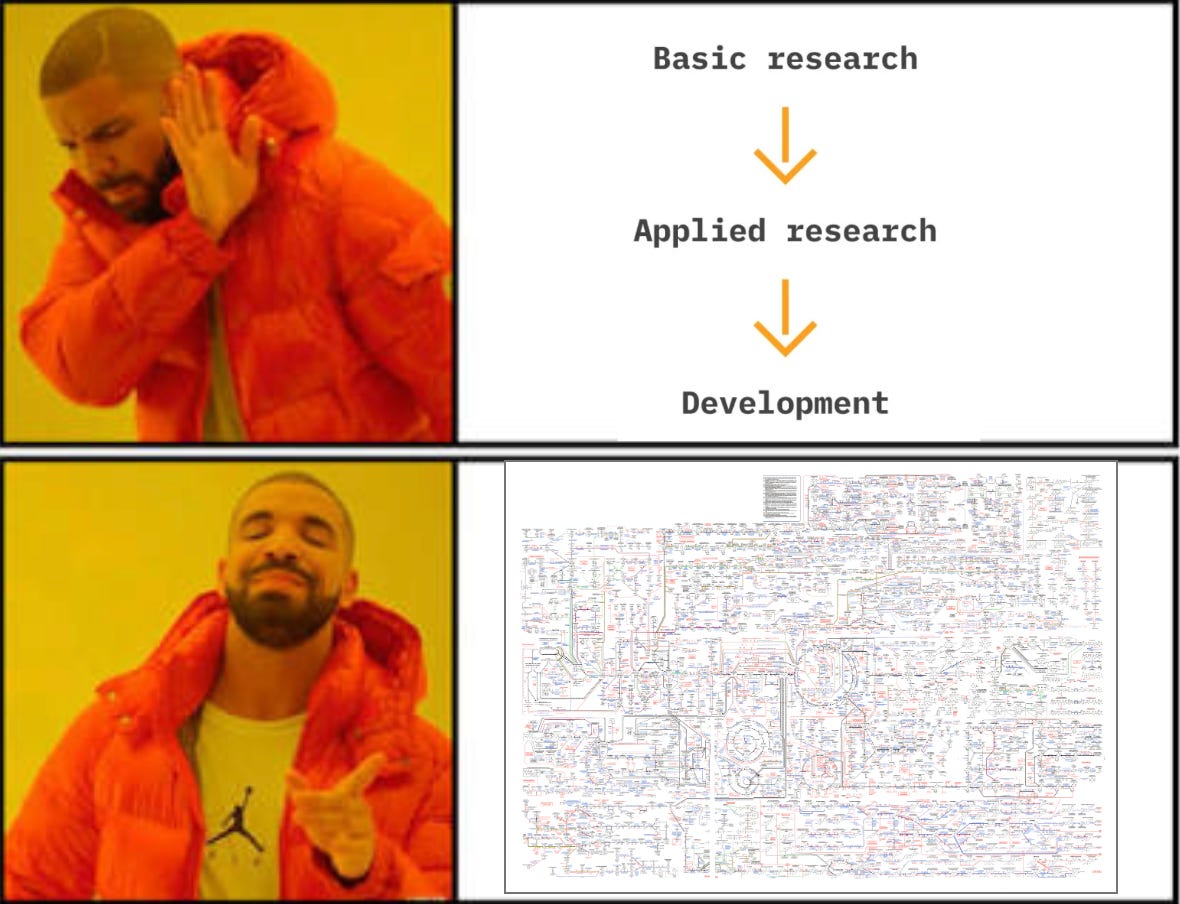
A cellular metabolism is the closest thing to an accurate model of “big S” science: how things go from ideas to impactful technologies or accepted theories about how the world works.
Instead of a few discrete categories, science actually consists of millions of people doing (thousands? Hundreds of thousands?) of different ‘flavors’ of interconnected work that turn ideas, observations, and raw material into knowledge and technologies that extend our understanding and capabilities beyond our own hands, eyes, and heads. These interconnections create a complex system (in the technical sense of the word) which means that abstractions like the linear model or 2D models like Stoke’s Quadrants are unable to capture very important system dynamics.
There are far too many flavors of work to list, but to give you a sense of the granularity I’m talking about, nodes in the metabolism might look like:
Poking at a material at a lab bench
Building a tool so that people can do the work at a lab bench
Doing theory to explain that experiment on a white board
Figuring out the kinetics of that reaction at scale
Tinkering with a scaled production system (and sometimes realizing that there is a gap in theory or a lab experiment to be done)
Training new researchers to do more of this work
Arguing about how resources should be allocated to do each of these things
All of this work then happens within institutions. (I use “institution” here in the sense of “a category of organization that shapes people’s behavior through a shared set of norms and incentives.”) Any flavor of work can theoretically be done in any institution, but different institutions are better or worse places for different flavors of work: universities are great places for whiteboard theorizing, for example, but bad for creating products; high-growth startups are the opposite; neither are good places for creating entirely new technology systems like the personal computer or self-improving factories.
Organizations and institutions get good at a specific subset of work. Most institutions are bad at admitting and embracing that fact. One of the competitive advantages we could have is being explicit about the flavors of work that our organizations do and do not do and take advantage of the wonders of specialization.
The thing that makes a metabolism or an ecosystem work is the interconnections between metabolic processes or ecosystem niches. Ideas rarely become reality while staying entirely within a single organization (or even usually a single group of people). These interconnections are where we currently fail. We have not really figured out how to lower the friction for ideas moving between different niches in the ecosystem — especially in a way that makes our research a more valuable product. If we could figure that out, people might bias towards supporting non-traditional organizations because they’re hooked into a more efficient metabolism.
The second way that an “independent research ecosystem” could help sell research is by becoming a value-enhancing category.
“Independent research” is itself not a product. It’s not even a product category. Perhaps it could become one — something like “organic” or “fair trade.” But nobody buys an organic apple just because it’s organic. They buy an organic apple because they want an apple and they believe an organic apple is superior to a normal apple.
People believe organic products are superior for two reasons.
The first reason is marketing. If you take a normal banana, slice it in half, and have people sample each half while telling them one is organic and the other is not, they will rate it as more delicious. That psychological flavoring is downstream of great marketing. Yes, we’re going to need to do much better marketing (which we are notoriously bad at).
This marketing needs to implicitly or explicitly answer the question “in what way is your product superior to the incumbent offering?” I don’t think “well, those guys are old-school and we’re not them” is going to cut it. One spicy possibility, though, is that “independent research” could become “fair trade” for certain ideological groups; a way of signaling to their peers.
The second reason people are willing to pay more for some categories is that they have actually experienced superior products in those categories! Produce rots more quickly without chemicals so most organic produce is fresher. Fresh produce is absolutely tastier, regardless of how it was grown. I would like to think that the new ecosystem can build a reputation for delivering superior research.
But that’s going to require a lot of hard work, time, and uncomfortably, incredibly high standards and some amount of internal policing. As a community, I’ve observed that we have a tendency to take a non-judgemental attitude towards other people’s research. There are good reasons for this! It is a reasonable reaction to the deep research conservatism and one-upmanship culture of academia. Indeed, a lot of incredible research does look crazy a-priori. But “all ideas are equally valid” is the wrong lesson to take from history and existing organizations. Most ideas and research are, frankly, garbage. If we want independent research to be a desirable category, we need to figure out how to make it become associated with quality.
There is an uncomfortable possibility that taking such an analytical and utilitarian view towards research support is, ultimately, self-defeating. That supporting research must ultimately be treated as a transcendent activity that’s incomparable to other uses of money. But that’s certainly not how it’s seen right now.
So in the meantime, as we try to build organizations and institutions that will hopefully come to define 21st century science, I want to encourage you to be in touch with reality. To ask “who are we selling to?” as individuals, organizations, and an ecosystem.
Bravo!
Well said. Research must have customers. The difficulty is finding enlightened ones