

Techno-economic analysis (TEA) should be the first point of contact between a technology in the lab and economic reality. TEA estimates the cost of a new product or process and lets you model how key variables or design choices, like process yield or temperature, affect cost. A good TEA saves time and money by showing if an idea is economically infeasible or if R&D is focused on solving an economically insignificant problem. Despite its value, the vast majority of early-stage scientists don’t do TEA.1
During my PhD, I worked on chemistry to fabricate transistors in chemical reactors rather than the controlled environments of a modern chip fab. The thesis was that chemical reactors are cheaper and have higher throughput than conventional fabrication equipment. The resulting low-cost transistors would then go into tiny sensors you could spray out of a hose with applications in climate, agriculture, and defense. At times, I questioned if that thesis was true. Would the cost of gold used in our process eat away at the savings from using cheaper reactors? If gold use was an issue, should I be spending my time finding a replacement material? What cost would we have to reach to have the impact we imagined? More broadly, would changing one (important) process in the long circuit fabrication sequence result in the cost reduction we hoped? I didn’t know.
It’s not surprising that I, like many other early-stage scientists, didn’t do a TEA. TEAs are hard. In the midst of running experiments and troubleshooting weird data, I would have had to take time to understand the economics of semiconductor fabrication broken down into process steps. Then, I would have had to wire up a spreadsheet to fit my analysis and spend hours searching for numbers that might not exist. It’s a daunting mixture of hard judgements and detail-oriented, tedious work to produce a result that I wasn’t sure I would trust anyway. It’s no wonder I chose to run the next experiment rather than sit down and do a TEA.
AI can change that calculus. On the data search side, AI can help with a lot of the work required to build a useful TEA: search broadly, read documents, extract values, normalize units, compare sources, and maintain records without getting bored. The more intellectually demanding effort of thinking of and scoping a TEA is less automatable, but agents can still be a help in two ways: (a) they can be good brainstorming partners and (b) they make the end-to-end TEA workflow much faster, giving you the freedom to make mistakes and iterate.
In the process of learning and doing early TEAs for our Brains fellows, I developed an AI tool to help me find data and build a model. If you are working on an early-stage technology, it might help you get started too.
The TEA tool
When designing an AI tool for TEA, I had three core attributes in mind:
Easy to use: The burden of use has to be substantially lower than doing a TEA with just a browser and a spreadsheet
Deterministic where possible: AI writes deterministic models where inputs can be substituted.
Auditable where non-deterministic: Every source, estimate, and equation is documented.
The workflow can start with a rough technology idea or a more detailed plan. It produces:
Plots that answer the questions posed by your TEA
The Python code for your model
A spreadsheet listing every variable along with the corresponding value, unit, link to source and a score for source quality
Importantly, these outputs are connected to an AI that can answer questions and make changes based on your feedback.
A quick example: changing the way we produce metal alloys
Here’s a quick summary of running a TEA entirely with the tool on Victoria Chernow’s 2026 Brains program. This was a demanding TEA that required modeling a sequence of 8 industrial processes. It took about 2 hours of human time which included an hour of brainstorming before starting and an hour of back and forth with the tool (answering scoping questions, spot-checking key values, and tweaking visuals). Unattended, the tool ran for another 4 hours.
Victoria’s program aimed to produce strong, lightweight alloys at a fraction of their current cost. Her thesis was that the incumbent process for manufacturing alloys is fundamentally inefficient. In that process, refining each constituent metal separately before alloying requires parallel multi-step processes that consume much more energy than thermodynamics requires.2 You can see that complexity clearly in the process diagram for Ti-6Al-4V alloy below.
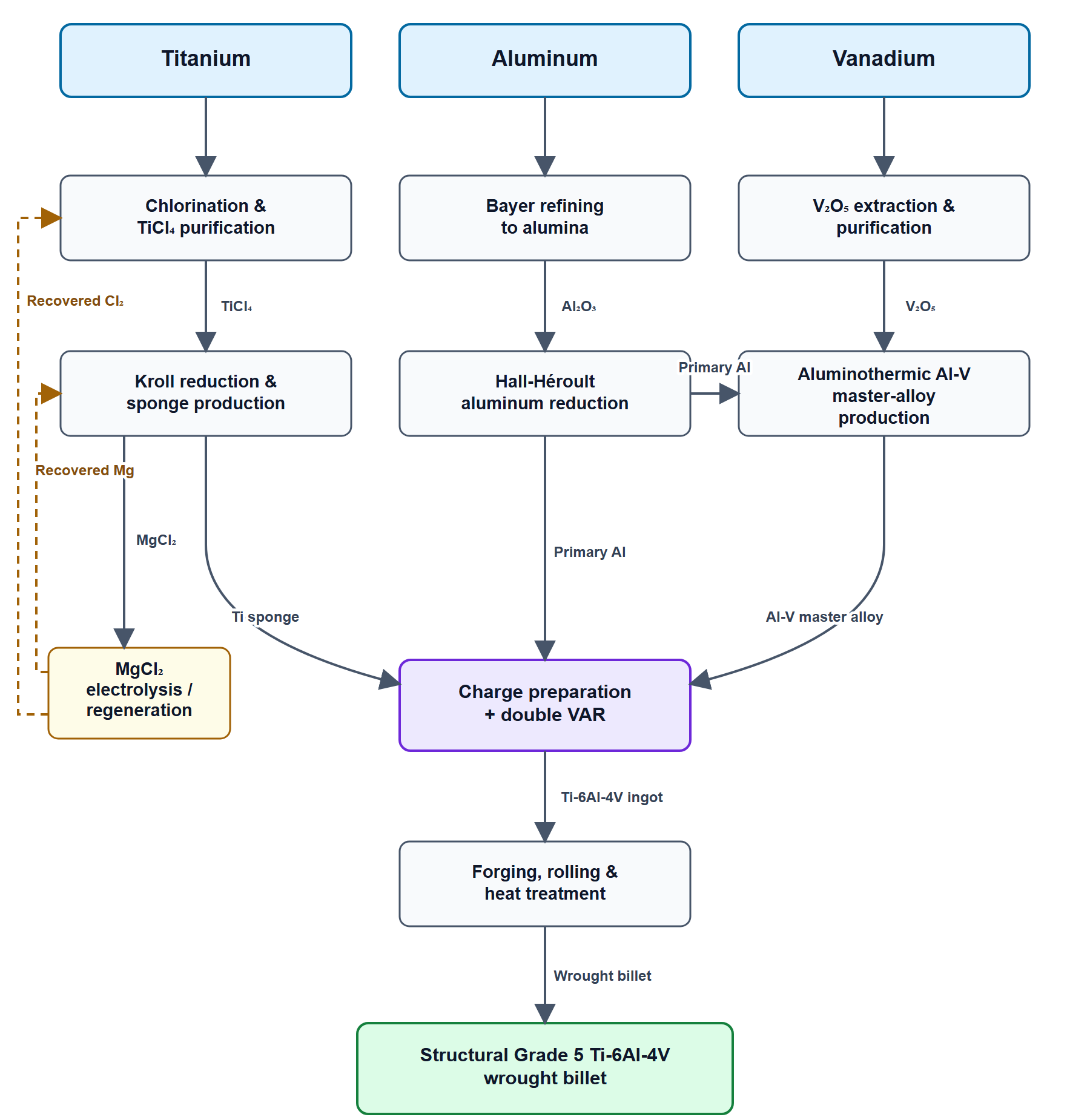
Emerging direct alloying chemistry like H2 co-reduction of metals3 promises to compress these long sequences of process steps. We need TEA to figure out if that process change could make the final alloys much cheaper, or if the cost is mainly tied up in input materials. If direct alloying technologies are economically promising, researchers (and funders) need to know whether to focus on reducing the number of process steps, reducing process energy, or improving metal recovery through each process. To answer those questions, I used the TEA tool to model the incumbent process of manufacturing Ti-6Al-4V alloy. The TEA examines CapEx, electricity, thermal energy, yield, and feed prices for each of the 8 steps involved in manufacturing the alloy starting from the three metal ores.
The headline result is that processing costs (specifically CapEx and electricity), not material costs, are the dominant cost contributors, accounting for 77% of alloy cost. Sensitivity analysis highlights the importance of metal recovery and how a reduction of the number of process steps relaxes the need for high metal recovery rates. These TEA results suggest that direct alloying approaches are addressing the key economic problem in alloy manufacturing, and that research should be focused on reducing process steps and process energy.
You can check out a more detailed walkthrough of this example in the appendix here.
Should you trust it?
In the direct alloying TEA run, the tool’s sources came back with this breakdown:
13% came from researched directly available data
57% came from estimates based on sourced data
28% were unbacked agent estimates
2% were locked inputs I provided
The high fraction of estimates makes sense here. Publicly available data is sparse on the specific titanium alloy used in the analysis. The tool leaned on estimates based on similar processes on other materials.
Without digging into those data sources and checking the tool’s work (which takes time), it can be hard to trust the results. As with any AI output, the level of trust and fact-checking should be calibrated to the magnitude of the decision that depends on it. Here’s how I’ve been thinking about this:
If you are testing the viability of an early-stage idea: Use auto mode in the data research step (/tea-data). You can do a few things to spot high-impact errors:
Check that the model’s headline outputs are close to benchmark values. The tool will research benchmark values for you, but double-check those. Example: In the direct alloying example, the modeled cost of the alloy was within 10% of the published market value.
Ask the tool which of the key values rely on low-quality sources and check those.
If you are deciding on an R&D focus: Use guided mode in the data research step (/tea-data) which stops at key steps of the TEA process and lets you check every source and estimate that the model uses.
If you are budgeting for a pilot plant: Treat this automated TEA as a way to understand the availability of data and prepare for discussions with a professional TEA advisor, industry experts, or engineering, procurement, and construction (EPC) firms.
How It Works
The Spectech TEA Tool runs on four sequential agent skills:
/tea-scope → /tea-model → /tea-data → /tea-insights
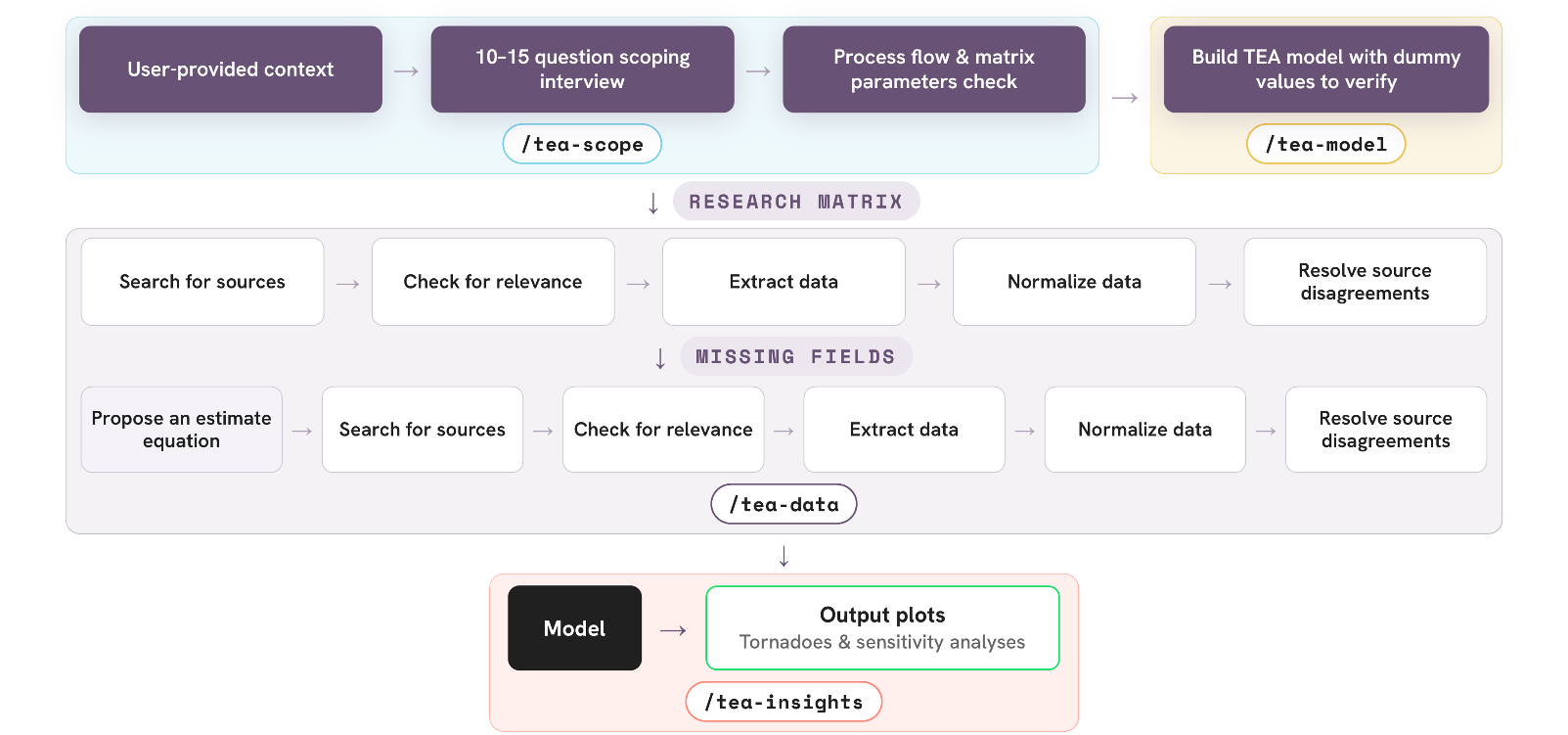
Your TEA begins by typing /tea-scope and providing context about the TEA you’d like to do. More context is often better, and as you’ll see in the appendix example, it can be as simple as listing a few questions you want the analysis to answer and attaching a doc you already have.
Here’s what happens next:
Through an extensive interview, the tool tries to get on the same page with you on the TEA’s scope. Based on that shared understanding, the /tea-scope skill ends with a set of TEA model specifications that feed into /tea-model.
In /tea-model, the AI plugs in dummy values for all of the variables to be researched and then builds the full model and its resulting visualizations. This both verifies that the model is solvable and gets the user’s input on whether the results would be meaningful if they used researched data.
The /tea-data skill goes through the matrix of variables that need to be researched, finding sources, extracting data, normalizing it to the model’s shape, and comparing data from different sources. If a value cannot be found on the public web, the model proposes estimation equations containing variables that are then researched through the same search–extract–normalize pipeline. All values, sources, calculations, and estimates are documented.
Finally, /tea-insights plugs the researched data into the model created by /tea-model and is there to answer any questions about the conclusions, data sources, and visuals and can tweak the data and model accordingly.
Limitations
While we hope this tool makes TEA more accessible, it has known limitations:
Reliant on publicly available data. Can’t access paywalled sources and doesn’t reach out to manufacturers for quotes.
The burden of verification still lies with the scientist. While agents have come a long way and we built the tool to minimize wild errors, it still leans on non-deterministic AI to research data and build models.
Doesn’t really understand physics. For example, the tool might not check if the energy intensity it proposes is below a thermodynamic minimum.
There is value in having human eyes on data sources. Sometimes an inefficient search with lots of rabbit holes can surface worthwhile insight.
Let me know if you run into any more or have ideas on how to mitigate these!
Try it on a real question
To set up the tool, give this GitHub repository to your favorite coding agent (Codex, Claude Code, Cursor, etc.) and ask it to set up the tool. Then ask it how to get started. Once you are ready, open a new thread, type “/tea-scope”, and tell the tool what you are working on.
For your first run, I’d recommend using Auto mode in the /tea-data step to iterate quickly. When you feel like you have the right TEA scope that you want to spend more time on, you can come back later and switch to guided mode to participate in step-by-step data review checkpoints.
Word of warning: this tool will burn through your coding agent’s usage limits. If you hit a usage limit, wait till your usage refreshes and simply ask the agent to continue.
Let me know what you think at daniel@spec.tech.
The tool isn’t going to answer all your techno-economic questions, and it isn’t perfect, but I hope it makes it easier to pick up the TEA that you’ve been putting off.
For more on TEAs:
For an overview of how to do a TEA, check out our Research Leader’s Playbook.
The folks at TEA Commons are working on similar LLM-based TEA tooling backed by a data repository focused on climate technologies. Would highly recommend checking it out here: https://www.tea-commons.org/tea-tooling
Appendix - More detailed walkthrough of Victoria’s TEA
This appendix contains a more detailed walkthrough of the scope and results of the direct alloying TEA example. It also includes the prompt I used to get started.
Victoria Chernow’s program scope outline:
Goal: Make high-performance, durable, lightweight alloys cheap enough to replace steel across industries such as construction and aviation.
Hypothesis: If we could condense the inefficient traditional multi-step alloying process into a single direct alloying step, we would achieve transformational cost and energy savings.
Questions: To validate the hypothesis that a process change can result in the needed cost savings, the program needed to answer several questions:
How much of the overall cost comes from processing (i.e., energy and equipment required for each step) and how much comes from the feedstock (i.e., the ore)?
If processing costs dominate:
How much would reducing the number of unit operations (and thus the amount of specialized equipment) impact the cost of alloys?
Would reducing the number of thermal cycles substantially reduce manufacturing cost and energy use?
If feedstock costs dominate:
How much could improved recovery of metals through the manufacturing process reduce costs?
What’s the minimum recovery rate needed in the direct alloying step?
If new approaches could take in lower-grade ores as the feedstock, would that substantially improve the economics?
This was my starting prompt:
/tea-scope I’d like to do a TEA to help me identify the key targets for a proposed ARPA-E research program. The program aims to produce high-performance alloys directly from ores, condensing the processes of metal reduction, alloying, and thermomechanical processing. This ARPA-style program should have targets that narrow the space down to direct alloying approaches without being overprescriptive. A few targets I have in mind are:
Max number of unit operations → Equipment cost (CapEx)
Max number of thermal cycles → Thermal energy (OpEx)
Use of lower-grade ores → Feedstock cost (OpEx)
Metal recovery → Feedstock quantity (OpEx)
Overall manufacturing cost → Cost (CapEx + OpEx)
I’d like to answer the questions:
How much does each target contribute to the cost of incumbent processing for manufacturing an alloy?
Which process steps in incumbent processing are the most costly?
Let’s use Ti-6Al-4V as the alloy to test in this TEA since it has a viable early-stage approach for direct alloying and potential to be an impactful structural material if its cost could be reduced significantly.
Attached is a 2-page brief about the program idea.
Example TEA results
The tool modeled the incumbent multi-step process for manufacturing Ti-6Al-4V billets (a rod-like intermediate alloy form) from ores according to this process flow shown earlier in the post.
The modeled cost of manufacturing Ti-6Al-4V billet was $24.22/kg (the publicly available benchmark market price is $23.26/kg so our model is within $1 of the market price4).
Breaking down the contributions to the final $24.22 manufacturing cost answers some of our initial questions about incumbent manufacturing of this example high-performance alloy:
The metal feed accounts for only 9% of the alloy cost, which means recovery improvements could only result in marginal cost reductions.
Processing costs (CapEx and electricity) are dominant cost contributors (77%).
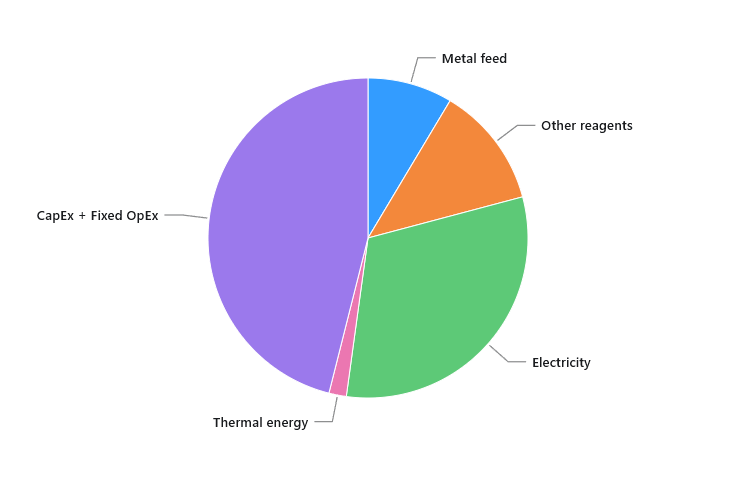
For this specific alloy (whose manufacture includes several electrochemical processes), electricity is the dominant share of energy use, not thermal energy.
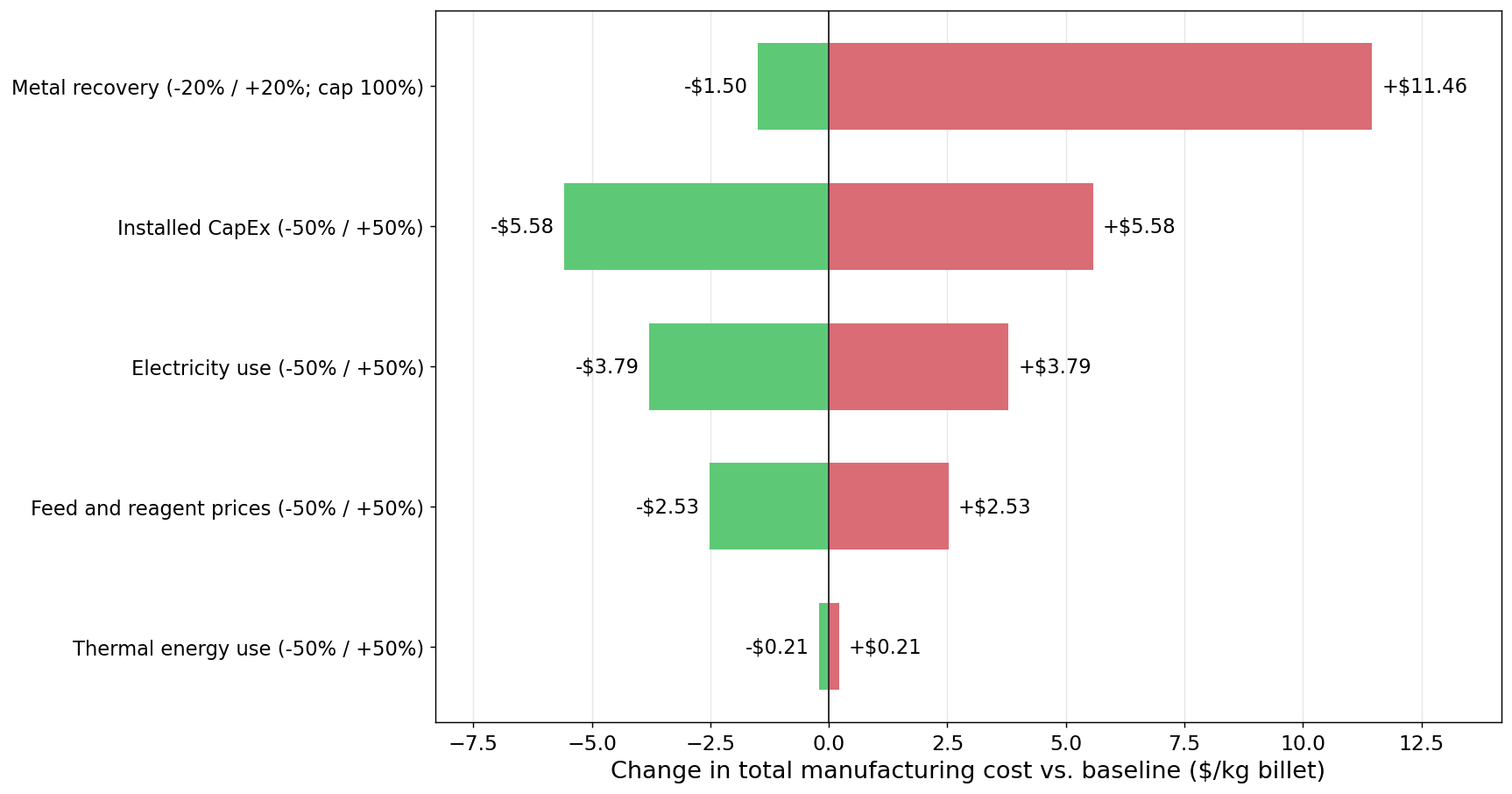
A tornado plot that shows the sensitivity analysis from changing the key inputs by fixed percentages supports the relative importance of CapEx and electricity but also reveals the importance of metal recovery. We see relatively small cost savings and major cost increases from changing recovery rates. This is a result of the many processes which operate in series to manufacture an alloy. A reduction in the fraction of metal that makes it through one process demands more production upstream to create the same amount of final product. Avoiding these cascading effects that occur in serial manufacturing processes is a key advantage of the direct alloying approach (3 sequential steps with 80% yield each are equivalent to one step with 51% yield).
Taking a step back, this TEA supports the direct alloying thesis and helps refine the right metrics for R&D. We modeled an 8-step process to reduce each of the primary metals from its ore and then alloy them together. It’s a tall task, but if a direct alloying technology could replace those eight steps with one process unit using one-eighth of their combined CapEx and energy (the incumbent process consumes ~20x the thermodynamic minimum energy), the modeled alloy cost would fall from $24.22/kg to $10.76/kg—about 56%. The TEA also helps refine the program’s metrics: Reducing CapEx and energy consumption (thermal and electricity) remain core metrics. Accepting lower grade ores to reduce feedstock costs is a lower priority target.
Jesse Lou, Rosie Keller, and Teasha Feldman-Fitzthum, Building the Open Analytical Infrastructure to Accelerate Lab-to-Market Commercialization, TEA Commons.
Shaolou Wei, Yan Ma, and Dierk Raabe, One step from oxides to sustainable bulk alloys, Nature 633, 816–822 (2024). DOI: 10.1038/s41586-024-07932-w.
Argus Media, Argus Scrap Markets, Issue 26-22, 3 February 2026, p. 19. The 30 January 2026 Ti-6Al-4V ingot FOB U.S. producer range is $10.00–11.10/lb; its midpoint is $23.26/kg. This is an ingot benchmark, upstream of the modeled billet, used here as a benchmark proxy.